

Versatile, durable, and always useful. Our dumbbells and dumbbell sets work for warm-ups, accessory lifts, or a full standalone session. Grab a pair and get to work!




A dumbbell is a short, fixed-weight bar held in one hand, with weighted ends on both sides. A barbell is a long bar held with both hands simultaneously. The practical difference matters more than the definition: dumbbells force each side of your body to work independently, which exposes and corrects strength imbalances that a barbell lets you hide. Your stronger side can't carry the weaker one.
Dumbbell rows are one of the most complete back exercises you can do. The primary movers are the latissimus dorsi and rhomboids, but a properly performed dumbbell row also hits the rear deltoids, traps, and biceps as secondary movers. Brace your core throughout and you're getting stabilization work on top of that. If you've been skipping rows in favor of pull-ups or machines, you're leaving back thickness on the table. Rows and vertical pulling movements like pull-ups complement each other.
Both movements work the chest, shoulders, and triceps, but the angle changes the emphasis. A flat dumbbell press targets the mid and lower chest. The incline dumbbell press shifts the load toward the upper chest and increases anterior deltoid involvement. For most lifters, the upper chest is underdeveloped relative to the mid chest, which makes the incline press a high-value addition. Set the bench between 30 and 45 degrees; steeper than that and it becomes more of a shoulder press than a chest movement. Use both variations in your program for complete chest development.
Fewer than you think to start, more than you think eventually. A practical starting point is three pairs: one light set for isolation work like lateral raises and curls, one medium set for pressing and rowing, and one heavier set for goblet squats, Romanian deadlifts, and heavier compound work. From there you fill gaps as your strength grows. If budget is a constraint, prioritize the medium range first, those weights handle the most movements. A 25 lb and 35 lb pair covers more ground than most people realize when you're starting out.
You can build significant strength with dumbbells alone, particularly in the 8 to 20 rep range where hypertrophy happens most efficiently. The limitation shows up at very heavy loads, a 100 lb dumbbell press is genuinely impressive, but loading a deadlift or squat to serious weights with dumbbells gets impractical fast. For most garage gym lifters, the answer is both: a barbell and rack for the foundational compound lifts, and dumbbells for accessory work, isolation movements, and filling the gaps a barbell can't reach. Each tool does things the other can't.
Dumbbells: The Most Useful Tool in Your Garage Gym
A dumbbell is exactly what it sounds like: a short, fixed-weight bar with weighted ends on both sides, held in one hand. Simple. But if you've been training for any length of time, you already know that simple doesn't mean limited. Dumbbells are the most versatile piece of equipment in any garage gym, and for good reason.
You can warm up with them, finish a session with them, or build an entire program around them. They work for beginners learning movement patterns and for experienced lifters chasing hypertrophy. They fix muscle imbalances that barbells mask, build stability that machines can't train, and travel with you anywhere. A pair of dumbbells and some floor space is a complete workout. A full rack of them is a complete gym.
Fringe Sport dumbbells are built to the same standard as everything else we make: durable, honest, and worth what you pay.
What Can You Do With Dumbbells?
More than most people use them for. Here's a look at the movements that belong in every garage gym program.
Incline Dumbbell Press
The incline dumbbell press is one of the best upper chest builders available. Set your bench to 30 to 45 degrees, press from shoulder height to lockout, and let the dumbbells travel in a natural arc rather than the fixed path a barbell forces. The incline dumbbell press works the upper pec, anterior deltoid, and triceps; with more range of motion and less shoulder strain than a barbell incline press for most lifters. If you've been asking what the incline dumbbell press works and whether it's worth adding, the answer is yes on both counts.
Dumbbell Shoulder Press
The dumbbell shoulder press builds overhead strength and shoulder stability at the same time. Because each arm works independently, your dominant side can't compensate for the weaker one the way it can on a barbell press. That makes it one of the most effective movements for building balanced shoulder strength. Press strict, control the descent, and keep your core braced. Seated or standing, it works.
Dumbbell Row
If you want a stronger back, dumbbell rows belong in your program. A dumbbell row is a single-arm pulling movement where you brace one hand and knee on a bench, hinge forward, and pull the dumbbell from a dead hang up toward your hip. Dumbbell rows work the lats, rhomboids, rear delts, traps, and biceps, the full pulling chain. Done correctly, they build the kind of back thickness that carries over to deadlifts, pull-ups, and everything else. Learning how to do dumbbell rows properly comes down to one cue: lead with your elbow, not your hand.
Dumbbell Lateral Raise
The dumbbell lateral raise isolates the medial deltoid, the part of the shoulder that creates width. It doesn't load heavy and it doesn't need to. Controlled, full-range lateral raises done consistently build shoulder caps that no pressing movement fully develops on its own. Keep the weight light enough to move through the full range without shrugging at the top.
Curls, Skull Crushers, Flyes, and More
The dumbbell is the best tool for accessory work. Hammer curls, concentration curls, tricep kickbacks, chest flyes, rear delt flyes, goblet squats, Romanian deadlifts, the list of effective dumbbell exercises is long, and all of them earn their place in a well-rounded program.
Which Dumbbells Does Fringe Sport Carry?
Dumbbell Pairs — 2.5 to 100 lb
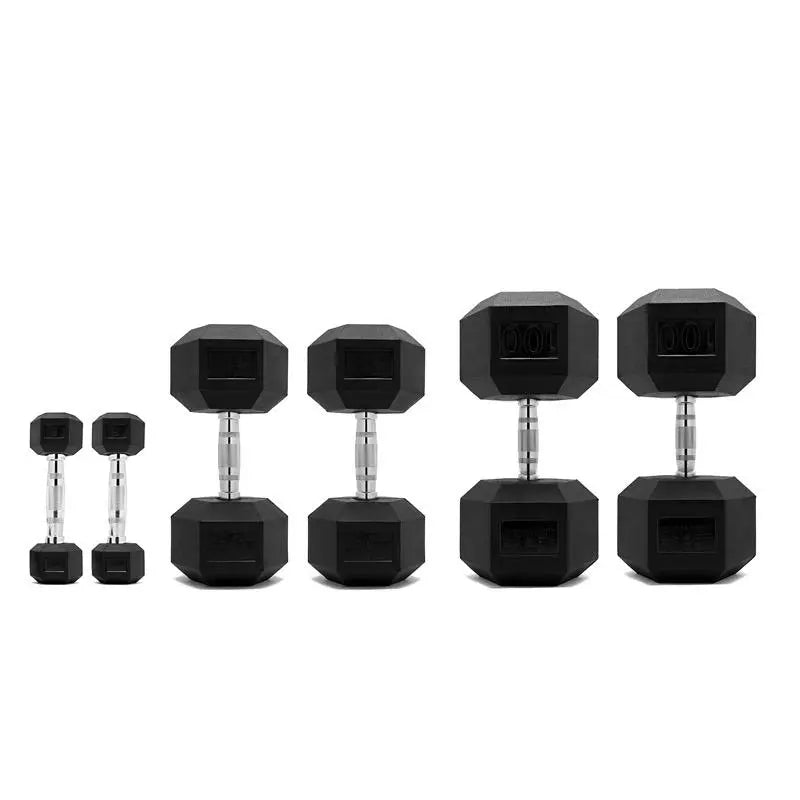
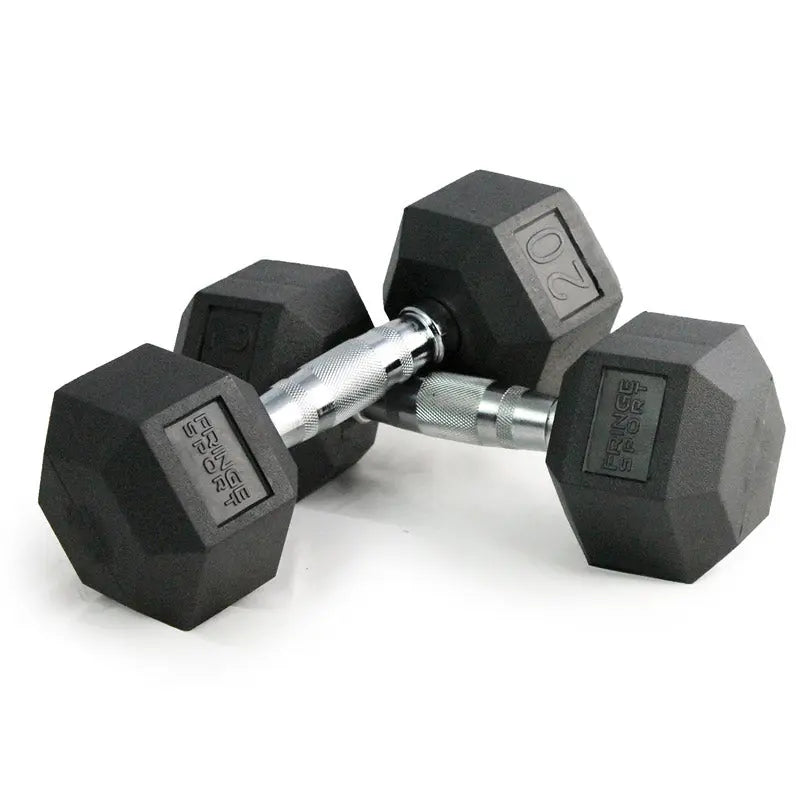
Buy by the pair or build a set. Our rubber hex dumbbells are the practical choice for garage gym use, the hex shape keeps them from rolling, the rubber coating protects your floor, and the knurled handles give you grip without tearing your hands up on high-rep sets. Available from 2.5 lb up to 100 lb so you can start light and grow your set as your training does.
The flat ends double as a stable base for push-up variations and renegade rows, which gives you even more movement options without buying anything extra.
What Weight Should You Start With?
This depends on what you're training for and where you are right now.
For most beginners, a set that covers light, medium, and moderately heavy dumbbells handles the full range of what you'll need: something in the 10 to 15 lb range for shoulder work and lateral raises, something in the 25 to 35 lb range for rows and presses, and something heavier for goblet squats and Romanian deadlifts. As a general rule, if you can complete 15 clean reps without breaking form, you need to go heavier.
For experienced lifters adding dumbbells to an existing setup, start with your weakest movement and buy the weight that challenges you there. Everything else will catch up.
Why Dumbbells Beat Machines for Most People
Machines fix your movement path, which reduces stability demands and often lets you move more weight. That sounds like a good thing. The problem is that real strength (the kind that carries over to daily life, sport, and other lifts) requires your stabilizers to do real work. Dumbbells force that. Every dumbbell press, row, and lateral raise requires your joints and smaller muscles to control the movement from start to finish.
For garage gym lifters who want maximum return from minimal equipment, a solid set of dumbbells handles more of your training needs than any machine at any price.